
Vessels are built and designed to transport essential commodities across the oceans. These vessels come in different types, and each vessel plays a crucial role in the global supply chain. Understanding the types of ships and their functions, capacities, and contributions provides a significant insight to stay connected with the global economy.
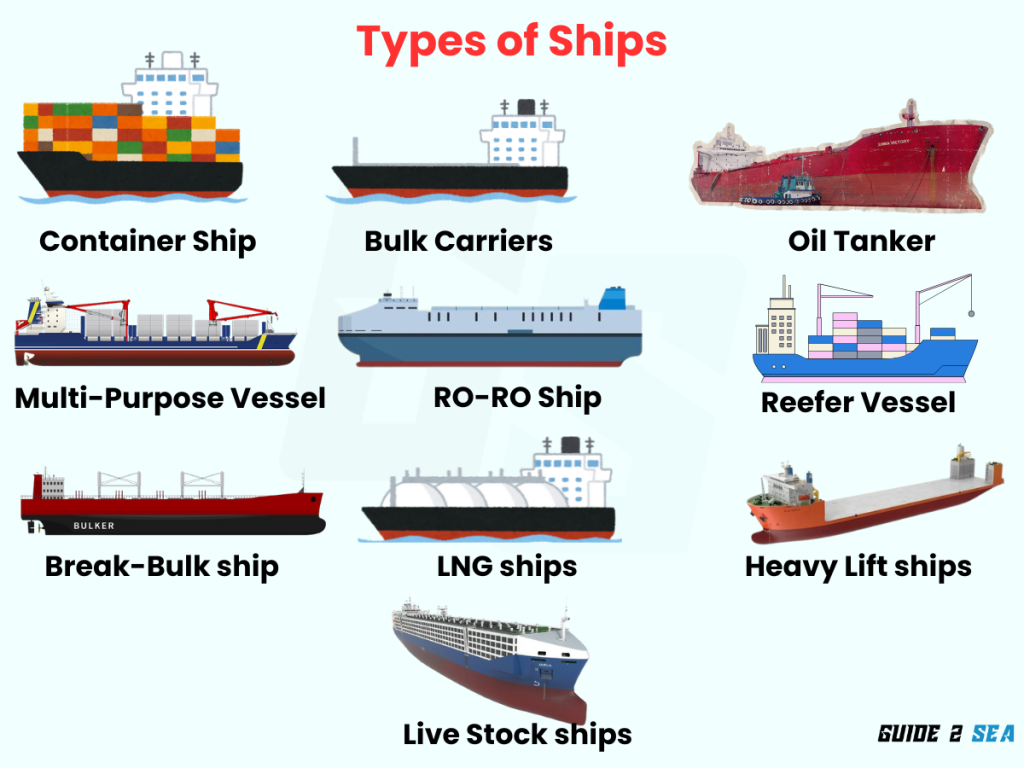
1. Container Ships
Among the vessels, container vessels are the most widely used cargo vessels. Container vessels are designed to transport standardized shipping containers, and they vary in size. The largest container ships can carry up to 24,000 TEU. These vessels transport a wide range of goods, including electronics, machinery, garments, etc.
2. Bulk Carriers
Bulk carriers, or “bulkers,” are types of ships specially designed to transport large quantities of unpacked goods such as ore, coal, grain, and iron. These vessels come in various sizes. Some bulk carriers are equipped with onboard cranes for self-loading and unloading processes, large cargo holds, and hatch covers to protect cargo from external elements, and ballast tanks to maintain stability while sailing. These vessels have a capacity to carry up to 400,000 DWT.
3. Oil Tankers
Oil tankers are specially designed to carry liquid cargo, basically crude oil and petroleum products. These vessels come in different sizes, including Aframax, Suezmax, Very Large Crude Carriers (VLCC), and Ultra Large Crude Carriers (ULCC), and have a capacity to carry up to 500,000 DWT. Most of the oil tankers are designed with double hulls and segregated ballast tanks for safety and to reduce pollution from oil.
4. Multi-purpose Vessels
Multi-purpose vessels are a type of vessel designed to carry a variety of cargo types, including containers, breakbulk cargo, or bulk cargo. Regions with limited port infrastructures widely use these types of vessels to have flexible transportation within one voyage. These vessels are equipped with cargo holds, container fittings, and onboard cranes to handle diverse types of cargo. Multi-purpose vessels are a cost-effective solution in shipping.
5. Roll-on/Roll-off (Ro-Ro) Vessels
Ro-Ro vessels are specialized in carrying wheeled cargo such as cars, trucks, trailers, and heavy machinery. These vessels are equipped with ramps to be driven directly on and off of the vessel. Ro-Ro vessels are also classified into different types, and they are used in automobile transport. As global trade and vehicle production continued to expand, Ro-Ro vessels played a crucial role in the seamless transportation of automobiles and rolling cargo across the international market.
6. Reefer Vessels
Reefer vessels typically transport perishable items such as fruits, vegetables, meat, and seafood under controlled temperature conditions. These vessels play a crucial role in the global supply chain by ensuring that temperature-sensitive cargo reaches its destination while maintaining freshness and quality. These vessels are equipped with insulated cargo holds and active refrigeration systems that can maintain temperature.
7. Break Bulk Ships
Break bulk ships carry unpacked goods in bulk that are not containerized. These vessels are equipped with large cargo holds, hatch covers, and onboard cranes for self-loading and unloading processes. Machinery parts, construction materials, steel products, heavy equipment, or irregular-shaped cargo are typically transported in breakbulk ships. The stowage planning of these vessels is complex.
8. LNG (Liquefied Natural Gas) Ships
LNG ships, or liquefied natural gas carriers, are common types of vessels designed to transport natural gas in its liquefied form at lower temperatures. Safety is a top priority in LNG ships with strict international regulations in cargo handling, crew training, and emergency procedures. High cost of vessel construction, complex loading and unloading procedures, and the need for specialized terminals are challenges in LNG vessel operations. Q-max class LNG carriers are the largest type of carriers in the world.
9. Heavy Lift Ships
Heavy lift ships are specially designed to transport Out-of-Gauge (OOG) cargo, which is oversized and extremely heavy. These vessels are essential for industries such as construction, gas, and oil, where large structures and equipment are transported across the world. These vessels are equipped with powerful cranes to lift and transport heavy loads, such as turbines, transformers, and massive construction materials. The role of heavy lift ships is crucial in global trade.
10. Livestock Ships
Livestock ships are specialized vessels designed to transport live animals such as cattle, goats, and sheep over long distances by sea. These vessels play a crucial role in the global meat and dairy supply chain, ensuring safe transportation of livestock. Transporting live animals is a unique challenge, as it includes maintaining animal health, managing waste disposal, and preventing the spread of diseases. These vessels are equipped with ventilation systems, feeding and watering facilities, and a waste management system to provide proper care for animals during the transit.
The maritime industry relies on various specialized ships to transport different types of cargo across the world. Each type of vessel has its challenges to maintain cargo safely until it reaches the destination port. However, the advancements in technology and regulations are making these ships more efficient and environmentally friendly. Together they support global trade by moving essential goods across the world’s oceans.
Thank you for your sharing. I am worried that I lack creative ideas. It is your article that makes me full of hope. Thank you. But, I have a question, can you help me? https://www.binance.info/register?ref=IXBIAFVY