Maritime law is also known as admiralty law. This is the body of law that governs the maritime and marine-related issues in international trade in the seas. To govern, operate, and inspect these maritime-related activities or issues, international rules, regulations, and conventions have been implemented in the world. Through these rules, regulations, and conventions, the majority of maritime-related issues are governed.
Most of the countries in the world follow their respective guidelines under international maritime law and are governed independently from the internal laws of the nation. The International Maritime Organization (IMO) plays a key role in maintaining and updating international guidelines in maritime law when necessary.
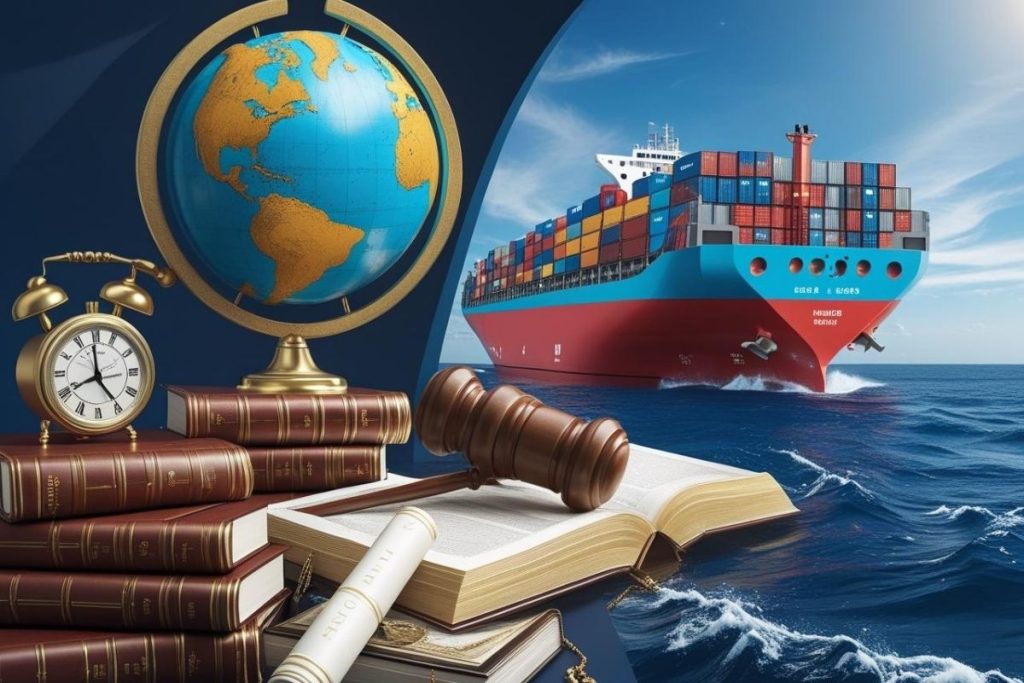
Reason to create of Maritime Law
Since ancient times, the sea has been a place of mystery, opportunity, and danger. From the earliest days of sailing, people understood that traveling and trading across the seas came with risks such as storms, piracy, shipwrecks, and disagreements over cargo or ownership. As a result, maritime law was not just something modern countries came up with. It has a deep historical overview going back thousands of years.
The earliest forms of maritime law can be traced back thousands of years to the ancient “Rhodian Sea Law,” in the ancient Eastern Mediterranean around 800 BC. This early set of rules helped settle disputes between merchants and sailors and laid the foundation for future maritime law. As trade routes expanded, ships became a more common object for transporting goods, and people saw the need for a common law that governs the activities of the sea.
As maritime trade began to expand in the “Middle Ages” in places like Europe and the Middle East, the need for a structured and standardized legal system arose. When cargo, like silk, spices, wine, timber, and gold, used to be carried by ships, the “Law of Oléron” originated, which can be marked as a significant milestone in the evolution of maritime law around the 12th century, centering on France and later encompassing the North European region
When the “Age of Exploration” began during the 15th and 16th centuries, European empires sailed across the world, competing for colonies and resources and controlling the sea routes, where complicated legal questions began to rise: “Who really owns the ocean? Is it fair for one country to power and control the ocean routes?” Based on these conflicts, nations needed a common understanding of rules for safe trade and navigation. One of the most famous philosophers, Hugo Grotius, who was in the 16th-17th century, brought the idea that the sea should be free for everyone, which is still an important concept in today’s maritime law.
With the rise of global trade in the 18th and 19th centuries, maritime trade became more complex. Ships got larger, crews were more international, and the journeys became longer; new dangers emerged. Accidents, piracy, insurance fraud, and pollution became major concerns. Such incidents led the way to shape the maritime law from the formal system of international law. Organizations like IMO (International Maritime Organization) were established in 1948 by the United Nations to regulate maritime law to cover everything from ship safety and seafarers’ welfare to environmental protection.
Where We Stand Today with Maritime Law
Over the years, history has proven that rules and regulations are needed to keep things running smoothly at sea. Currently, over 80% of international trade is carried by sea. Maritime law helps regulate international shipping by supporting global trade and the world economy.
With the growth of technology, it also shapes the maritime law with digital navigation. By now, as almost all the countries are a part of IMO (International Maritime Organization), they follow the same rules to govern everything from cargo handling and port operations to seafarers’ rights, ship registration, and environmental protection.
In the 21st century, with the demand for shipping businesses having increased, modern maritime law is made up of a mix of international agreements, industry standards, and law. Today maritime law expands to cover emerging issues such as piracy, maritime security, illegal fishing and human activities, climate change, and sustainable shipping.
In short, today’s maritime law is a global system that keeps shipping running smoothly while protecting the ocean, people who work on it, and the goods that move across it. It’s the legal backbone that was developed over centuries to support the international shipping and world’s economy. By now it has continued to grow and adapt with new technologies and challenges.