
Some moments in life we need extra help. We ask for help when a task feels too tricky. Maybe we need an expert to do something in a proper way.
Now imagine guiding something big. Really big. Something that cannot stop quickly. Something that needs careful attention at every turn. Even skilled people take help when the situation becomes sensitive.
Interestingly, the same thing happens at a port. Haven’t you ever wondered how these large ships enter into a port without damaging anything? Do you think it is the captain and the crew who navigate this ship into the dock? But the truth is, even the most skilled ship captain cannot do it alone. Every ship needs a special expert to guide these vessels into a port.
This expert is called a “pilot.” The work they do is known as pilotage.
This article explains pilotage in a simple and friendly way. You will learn who a pilot is, what pilotage means, why it is so important, and how it actually works in real life.
Who Is a Pilot?
When most people hear the word “pilot,” they think of airplanes. Someone flying a plane in the sky. But did you know the term “pilot” also applies to ships? That’s right! On the seas, rivers, and ports, pilots play a very important role. Unlike airplane pilots, marine pilots do not operate the ship from start to finish.

A marine pilot is often called a harbor pilot or port pilot. They are well-trained navigators who have deep knowledge about a specific port or waterway. Pilots know the local tides, depths, hidden dangers, traffic patterns, and port rules better than anyone else. The ship’s captain knows the vessel well, but the pilot knows the local port.
They guide vessels through narrow channels, shallow waters, or busy harbors. A pilot is not part of the ship’s crew. They work only within a certain port or coastal area. Because they know the area better than anyone else. Their job begins when a ship arrives near the port and ends once the ship is safely berthed or leaves the port.
What Is Pilotage?
Pilotage is a service of guiding a ship into a port with the help of a marine pilot. Pilotage is a global standard in shipping. Simply, the goal of pilotage is to navigate the ship safely.

Pilotage usually happens in a port, harbor, river, channel, canal, or even in anchorage. A pilot boards the vessel from a small pilot boat or sometimes a helicopter. After reaching the bridge, they work closely with the captain and crew. The pilot gives instructions on speed, direction, and maneuvering while the captain still keeps command of the ship. Together, they make sure the vessel enters or leaves the port safely. Even the biggest ships in the world safely navigate because of pilotage.
Although modern ships use radar, GPS, and electronic charts, pilotage still plays an important role. Because local knowledge cannot be replaced by technology alone.
How Pilotage Works
Pilotage is not a simple task. It is a team effort. Many people work together to move a ship. Let’s see how pilotage works.

- Requests a Pilot: Before a ship enters into a port, they should inform the port control. Then they assign a pilot.
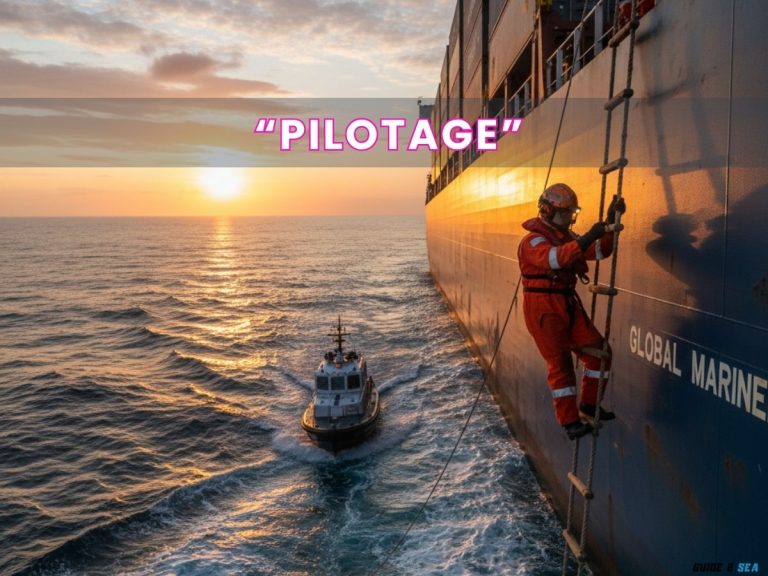
- Pilot Boarding: The pilot boards the ship using a rope ladder or sometimes a helicopter. This part is risky, especially in rough seas or in bad weather. Once aboard, the pilot is welcomed by the captain and crew.
- Master-Pilot Exchange (MPX): The captain and pilot exchange information about the ship, route, hazards, tug availability, and weather.
- Pilot Guides the Ship: The pilot gives clear instructions to the captain and crew. Commands include speed adjustments, course changes, and stopping when necessary.
- Tug Assistance: Large ships need help from tugboats. Pilots coordinate with tug captains by radio. They instruct them to push, pull, or slow down the ship.
- Passing Narrow Areas: The pilot ensures the ship stays centered in channels. They check the tide, current, and traffic. Their knowledge helps the ship avoid risky spots.
- Berthing: When the ship reaches the berth, the pilot gives final instructions to ensure the ship stops at the exact location.
- Leaving the ship: When everything is safe, the pilot leaves the ship. The pilot boat picks them up and returns to the station.
The process repeats when the ship is ready to leave the port.
Why Pilotage Is Important
Even with the modern technology, pilotage is still important. Let’s see why pilotage is so important.
- Safety of Ships: Ships are large and heavy. A small mistake can lead to collisions, groundings, or damage to cargo. Pilots prevent such accidents.
- Safety of Ports: Ports are always busy and crowded with ships and cargo. A single accident can halt operations, delay trade, and cause financial losses. Pilots keep ports safe and organized.
- Environmental Protection: Accidents like collisions or groundings can spill oil or chemicals. This harms marine life and pollutes water. Pilots help prevent such disasters.
- Assistance During Difficult Conditions: Pilots help ships navigate in rough weather, strong currents, fog, or low visibility. Technology cannot replace human need in these situations.
- Handling Large Modern Ships: Modern container ships, tankers, and cruise ships are very large. They require careful maneuvering in tight spaces. Pilots help them avoid accidents in harbors designed for smaller vessels.
- Efficiency and Time-Saving: Experienced pilots know the shortest, safest routes. It helps ships to save fuel and time. Tug coordination, traffic monitoring, and speed management ensure smooth operations.
Final Thought
Pilotage is an important part of global shipping. Marine pilots use their expertise and local knowledge to guide ships safely through challenging waters. They protect ships, ports, the environment, and people.
Even with technology improving every day, pilotage is still important because local knowledge cannot be replaced. Thanks to pilots, ships can enter and leave ports safely, global trade continues smoothly, and environmental risks stay low.
People Also Asks
Q1: How do pilots get to the ship?
Most pilots board using a pilot ladder from a pilot boat. In some places, they use a helicopter.
Q2: Why do ships need a pilot?
Ships need pilots because pilots know the local waters very well. Their experience helps avoid accidents and delays.
Q3: Are pilots former captains?
Many pilots start as ship officers or captains before receiving specialized pilot training.
Q4: Who pays for pilotage?
Shipowners or shipping companies usually pay as part of port fees.
Q5: Why can’t the captain navigate without a pilot?
Captains know the ship well. But they may not be deeply aware of local waters. Pilots understand every detail of the port, which increases safety.

